Cross-Market Signal Propagation
The Core Insight
Different markets react to the same event at different speeds. The time gap between when the first market reacts and the last market catches up — that gap is alpha.
This is not a theoretical concept. It is an observable, recurring phenomenon in crypto markets. When a major event breaks:
- Some markets react in seconds (often prediction markets or the most liquid perp pairs)
- Others take 30 seconds to several minutes to fully price in the information
- The lag varies by event type, time of day, and market liquidity
Which Market Moves First?
There is no fixed hierarchy. It depends on the event:
| Event Type | Typically Reacts First | Why |
|---|---|---|
| Policy / Regulatory | Prediction markets | Directly prices the event |
| Insider-Driven (votes, rulings) | Prediction markets | Insiders bet on the outcome |
| Exchange Hack / On-Chain | On-chain data, spot | Native to that market |
| KOL / Narrative | Social data, spot/meme | Retail-driven flow |
| Macro (Fed, CPI) | Perp futures | Professional traders act first |
Roma doesn't assume an order. It monitors all markets simultaneously and detects which one has moved and which hasn't — in real time.
How Roma Detects Propagation Gaps
The detection requires all three core systems working together:
| System | Role in Detection |
|---|---|
| Roma News | Identifies that an event has occurred |
| Roma Predict | Detects whether prediction markets have reacted (smart money verification) |
| Roma Perp | Checks whether perpetual futures have priced in the event |
| Probability Graph | Maps the event to expected asset impacts |
When one market has clearly reacted but another hasn't, Roma surfaces this as a propagation signal — a time-limited trading opportunity.
Example: Crypto-Friendly Legislation Passes
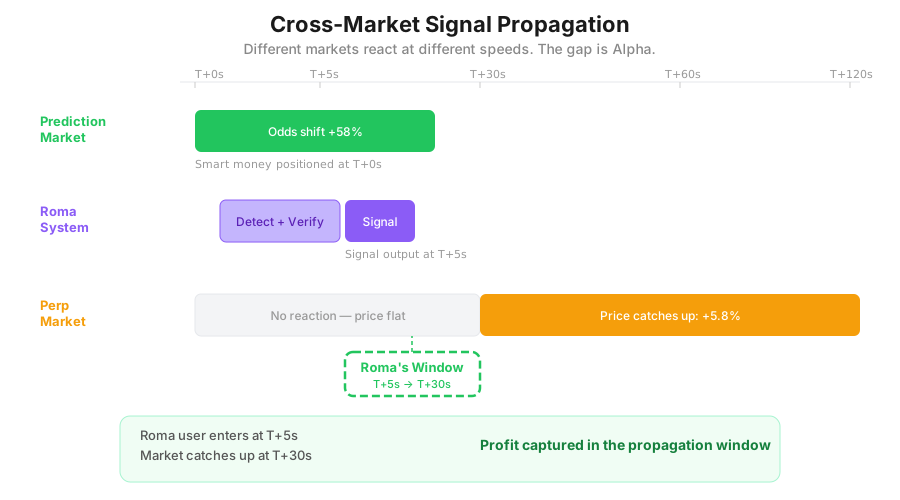
20:00:00  Event occurs — Congress passes crypto bill

20:00:02  Roma News:
          Reuters flash, 3 policy RSS feeds trigger
          Inference Layer 1 (80ms): Major bullish, importance 95/100

20:00:03  Roma Predict:
          Polymarket odds jump from 30% → 88%
          2 flagged smart wallets bought Yes at 20:00:01
          Verdict: Smart money confirms — high confidence signal

20:00:03  Probability Graph (3ms):
          "Crypto-friendly legislation" → BTC +6.5% (0.78 correlation, 9 events)
                                       → ETH +8.2% (0.82 correlation)

20:00:04  Roma Perp:
          BTC-PERP: no price change
          ETH-PERP: no price change
          Funding rate: normal
          Verdict: Perp market has NOT priced this event

20:00:04  → SIGNAL: Propagation gap detected.
          Prediction market reacted (+58% odds shift).
          Perp market has not reacted.
          Expected BTC impact: +6.5%. Window: ~30-90 seconds.

20:00:05  → Signal delivered to user or agent executes

20:00:35  BTC perp price begins rising
20:02:00  Price fully propagates: +5.8%
Roma user enters at T+5s. Market catches up at T+30s. The 25-second window is the alpha.
Counter-Example: False Signal Filtered
Not every apparent gap is a real opportunity. Roma's cross-validation prevents false signals:
15:00:00  Tier-2 KOL tweets: "SEC about to approve SOL ETF"

15:00:00  Roma News:
          Detects tweet, importance 72/100
          Single source, no official confirmation

15:00:03  Roma Predict:
          Polymarket "SOL ETF" odds: unchanged at 12%
          Smart money wallets: zero activity

15:00:04  → NO SIGNAL generated.
          Reason: Prediction market does not validate.
          Classified as: Unverified rumor.
The ability to filter false signals is as important as the ability to detect real ones. Without prediction market cross-validation, this KOL tweet might have triggered a trade.
Why This Is Defensible
Cross-market signal propagation detection is not a feature that can be bolted onto an existing platform. It requires:
- All three data systems running simultaneously — news, prediction market, and perp market data in real time
- An inference engine fast enough to process signals before the propagation window closes
- A calibrated probability graph to know which assets should be affected and by how much
- A risk/confidence framework to decide whether a detected gap is actionable
A competitor would need to build all four components and run them together. This is a systems-level moat, not a feature-level one.