Technology Overview
Roma's technical moat is not a list of features. It is a layered system where each layer reinforces the others.
Architecture
Two Core Technologies  →  One Self-Growing Moat  →  One Killer Application

Data Layer               Inference Engine         Probability Graph          Signal Propagation
(what we collect)        (what we build)          (what the system grows)    (what users capture)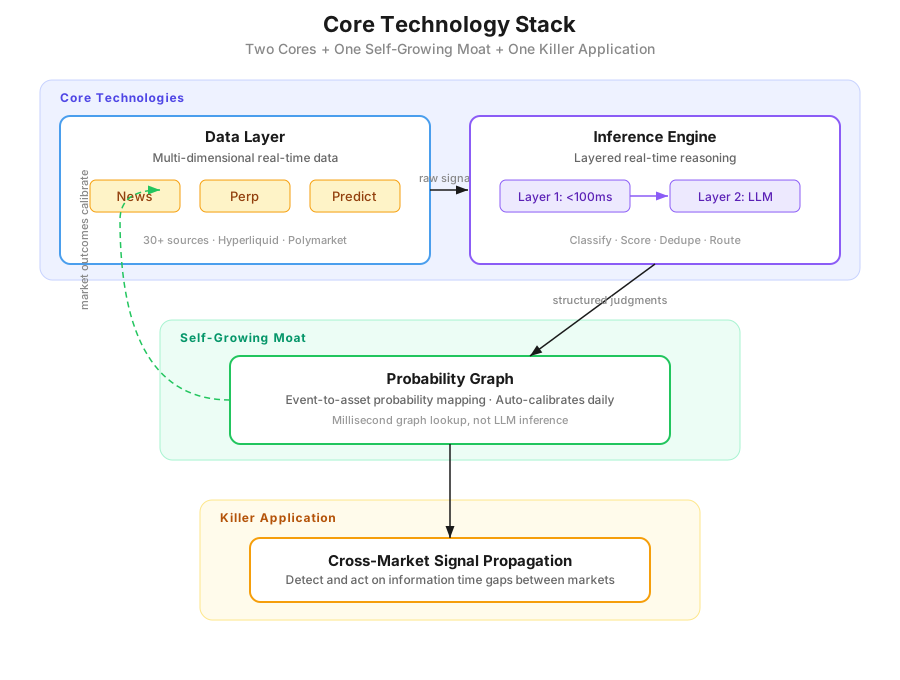
Two Core Technologies
1. Multi-Dimensional Data Layer
Roma simultaneously ingests real-time data from three dimensions that are usually completely siloed:
| Dimension | Sources | Product |
|---|---|---|
| News & Sentiment | 30+ sources (media, KOLs, on-chain, policy, community) | Roma News |
| Perpetual Futures | Hyperliquid (price, funding rate, OI, liquidations) | Roma Perp |
| Prediction Markets | Polymarket (odds, smart money, large trades, insider activity) | Roma Predict |
The moat is not any single source — it's having all three online and connected. A news-only platform can't verify signals against smart money flows. A perp-only platform can't see events coming. A prediction market platform can't map events to tradeable assets.
Key Insight
Any one dimension alone gives partial information. All three together give actionable conviction with cross-validation.
Learn more about the Data Layer →
2. Real-Time Inference Engine
A layered AI reasoning system that turns raw information into structured judgments in milliseconds — not the seconds that LLM API calls require.
| Layer | Speed | Function | Volume |
|---|---|---|---|
| Layer 1 — Lightweight Model | < 100ms | Classify, score, dedupe | Handles 90% of signals |
| Layer 2 — Deep LLM Reasoning | 2–3s | Event attribution, impact analysis | Only high-score signals |
The moat is the training data. Layer 1's domain-specific model is trained on labeled data from our 30+ source pipeline — data that no competitor has access to.
Learn more about the Inference Engine →
One Self-Growing Moat
Event-Asset Probability Graph
The Probability Graph is not a system we build separately. It is what emerges when the Data Layer and Inference Engine run continuously.
Every event processed, every judgment made, every market outcome observed — feeds back into a graph that maps events to their probabilistic impact on assets. The graph calibrates itself daily against real results.
Event occurs → Engine judges → Market reacts → Graph calibrates → Next event is more accurateAfter months of operation, the graph contains thousands of calibrated event-asset relationships that no competitor can replicate without the same data and the same time.
Time is the moat.
Learn more about the Probability Graph →
One Killer Application
Cross-Market Signal Propagation
When the two core technologies and the probability graph work together, they enable something no single system can do: detect when information has moved one market but not yet reached another.
Different markets react to the same event at different speeds. The time gap between when the first market reacts and when the last market catches up — that gap is alpha.
Roma is the only system simultaneously monitoring prediction markets, news feeds, and perpetual futures. When we detect that one market has priced in an event but another hasn't, we surface that as a trading signal — or act on it automatically.
Not a Fixed Hierarchy
Which market reacts first depends on the event type. Policy events may hit prediction markets first. Exchange hacks may show up on-chain first. Roma doesn't assume an order — it detects the actual gap in real time.