Multi-Dimensional Data Layer
The Problem with Single-Dimension Data
Every existing crypto intelligence platform sees only one slice of the market. Kaito sees news. Nansen sees on-chain data. Hyperliquid sees its own order flow. Polymarket sees prediction odds.
None of them can answer the question that matters: "Is this signal real, and which market hasn't priced it in yet?"
Answering that requires seeing multiple markets simultaneously.
Three Dimensions, One View
Roma ingests real-time data from three dimensions that are usually completely siloed:
| Dimension | What It Sees | Key Data |
|---|---|---|
| Roma News | What is happening | 30+ sources: media, KOLs, policy, on-chain, community |
| Roma Predict | Who knew first | Polymarket odds, smart money flows, insider activity |
| Roma Perp | Where the gap is | Hyperliquid price, funding rates, OI, liquidation maps |
Cross-Validation in Action
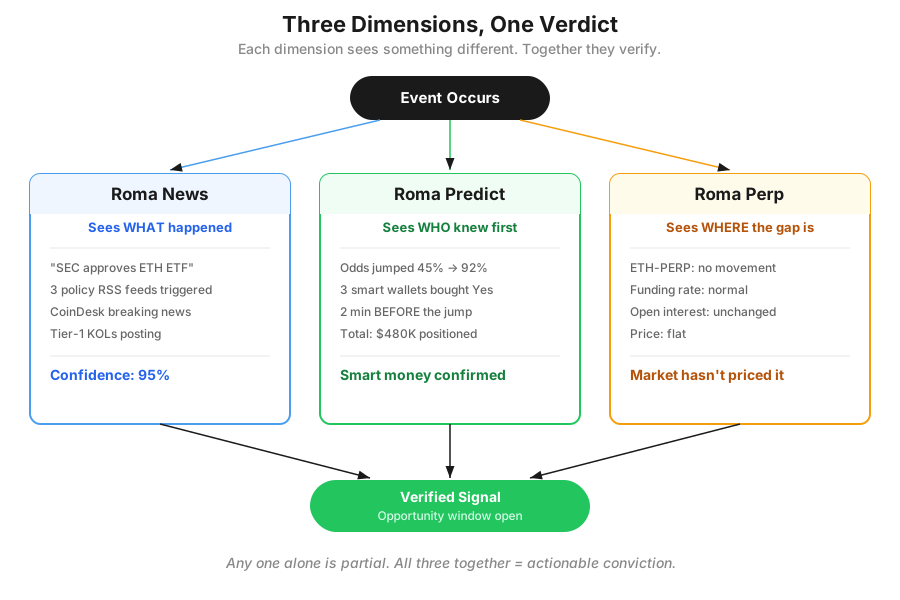
Example: SEC Approves ETH ETF
When this event occurs, each dimension sees something different:
Roma News detects:
- SEC official RSS feed pushes new filing
- CoinDesk publishes breaking news
- 3 Tier-1 KOLs post simultaneously
- Confidence: 95%
Roma Predict detects:
- Polymarket "ETH ETF Approved" odds jump from 45% → 92%
- 3 flagged smart-money wallets bought Yes 2 minutes before the jump
- Total positioned: $480K
Roma Perp checks:
- ETH-PERP price: no movement
- Funding rate: normal range
- Open interest: unchanged
The Verdict
Any one dimension alone is incomplete:
- News only: You know what happened, but is it real or rumor? No way to verify.
- Prediction market only: Odds shifted, but what asset should you trade? No answer.
- Perp only: Price is flat, but you don't know something big just happened.
All three together: The event is real (news confirmed), smart money already validated it (prediction market confirmed), and the perp market hasn't reacted yet (opportunity confirmed).
Counter-Example: Filtering False Signals
A Tier-2 KOL tweets: "SEC about to approve SOL ETF."
- Roma News: Detects the tweet, scores importance 72/100
- Roma Predict: Polymarket "SOL ETF" odds — no change, stuck at 12%. Smart money wallets — zero activity.
- Verdict: Signal filtered as unverified rumor. No trade signal generated.
Without prediction market cross-validation, this could trigger a false trade. The ability to filter noise is as valuable as the ability to detect signal.
Data Source Coverage
News & Sentiment (Roma News)
| Category | Sources |
|---|---|
| On-Chain | GMGN signals, whale alerts, DeFiLlama, OKX smart money, Binance listings |
| Media | CoinDesk, TheBlock, OKX sentiment, Chinese financial media |
| KOL | Twitter Tier-1/2/3 monitoring, tweet aggregation |
| Finance | Wall Street CN, Cailian Press, Yahoo Finance |
| Community | Reddit, Twitter trends, Weibo, Binance Square, Discord |
| Policy | SEC, CFTC, Fed RSS, White House, Truth Social |
Perpetual Futures (Roma Perp)
| Data | Update Frequency |
|---|---|
| Mark / Last Price | Real-time WebSocket |
| Funding Rate | Real-time + historical |
| Open Interest | Real-time + historical |
| Liquidation Data | Real-time |
| Order Book Depth | Real-time WebSocket |
| Trader Leaderboard | Near real-time |
Prediction Markets (Roma Predict)
| Data | Update Frequency |
|---|---|
| Event Odds (Yes/No) | Real-time |
| Odds History | Continuous |
| Smart Money Wallets | Tracked + profiled |
| Large Trades (>$10K) | Real-time alerts |
| Insider Activity Detection | Algorithmic, near real-time |
| New Market Creation | Monitored |
Why This Is a Moat
The data layer compounds over time in two ways:
- Volume: More sources, more events processed, more labeled training data for the inference engine
- Cross-market calibration: Every event-outcome pair calibrates the probability graph across all three dimensions — a calibration that requires all three data streams
A competitor can replicate any single dimension. Replicating all three simultaneously, with the cross-validation logic and historical calibration data, requires building three separate production systems and running them long enough to accumulate meaningful data.